ANALYSIS

Special Reports

Special reports are original research conducted by APLN experts in order to explore topics with depth and nuance and to inform policy-making.

Special Reports
21 Oct 2024 Innocentia ATCHAYA
Kristy Tsun-Tzu Hsu writes on the evolving cross-strait relations under the Lai Ching-Te administration, examining how Taiwan’s political landscape and public opinion are shaping the island’s future amid rising tensions with China.
Special Reports
19 Sep 2024 Manpreet SETHI, Sang-Hyun LEE and Eunjung LIM
APLN summarises the first year of the Asia Dialogue on China-US Relations in a report that analyses regional preferences for US and Chinese primacy in the region.
Special Reports
05 Dec 2023 Hyun CHO and Jina KIM
An APLN-VERTIC feasibility study report summarising the findings of the joint project and discussing confidence and security building options for the future.
Special Reports
20 Jul 2023 Jina KIM and Jiyoung KO
Dr Collin Koh’s report surveys the effectiveness of multilateral CSBMs in the Southeast Asian maritime domain.

Policy Briefs

Policy Briefs
06 Dec 2024 Jina KIM
Enkhsaikhan Jargalsaikhan argues that Mongolia’s rich experience should serve as a tool to strengthen and further broaden the Nuclear-Weapon-Free Zone regime.
Policy Briefs
07 Sep 2023 Eunjung LIM and Innocentia ATCHAYA
Gabriela Bernal identifies the conflicts of interest between the stakeholders on the Korean Peninsula that prevent them from pursuing a peace agreement.

Commentaries

Commentaries
15 Apr 2025 Nobuyasu ABE and Innocentia ATCHAYA
Adil Sultan argues that all nuclear-armed states, including India and Pakistan, must conduct regular nuclear ‘fail-safe’ reviews to build confidence, reduce risks of miscalculation or accidents, and prevent escalation during crises.
Commentaries
28 Aug 2023 Karla Mae PABELIÑA and Nobuyasu ABE
Kyoko Hatakeyama examines the Maritime and Air Communication Mechanism (MACM) between China and Japan as a maritime CBM in Northeast Asia.

The Pulse

Timely and incisive analysis on new policy debates and developments in the Asia Pacific.

The Pulse
07 Mar 2025 Hyun CHO, Jina KIM and Sang-Hyun LEE
Five international security experts discuss efforts to advance gender equality and expand leadership opportunities for women in the field, as well as the steps needed to accelerate progress.
The Pulse
14 Nov 2024 Hyun CHO, Sang-Hyun LEE, Eunjung LIM and Jina KIM
Six senior experts from the Asia-Pacific touch on what a second Trump Presidency in the United States would mean for the region.

The Korea Times Column

APLN publishes the APLN-Korea Times column in cooperation with the oldest daily English newspaper in Korea, featuring analysis by APLN network members and experts.

The Korea Times Column
19 Mar 2025 Nobuyasu ABE
Kazuko Ito argues that Japan, as the only country to have suffered from nuclear warfare, must take a leading role in preventing nuclear war and achieving a nuclear-free world by joining the TPNW, emphasising the growing need for global nuclear disarmament.

The Korea Times Column
05 Dec 2024 Marty NATALEGAWA
Kazuko Hikawa explores how the Pact for the Future’s emphasis on solidarity is hindered by its lack of concrete solutions and the divisive dynamics of global politics and economics, and suggests Christian Felber’s “Economy for the Common Good” as a framework to prioritize cooperation and shared human values.
The Korea Times Column
25 Nov 2024 Jiyoung KO
Jargalsaikhan Enkhsaikhan explains the options available to Mongolia if South Korea were to go nuclear.

Statements

APLN statements are published in response to significant events relevant to global nuclear diplomacy.

Statements
31 Oct 2024 Eunjung LIM
APLN Chair Dr Marty Natalegawa greets the Nihon Hidankyo organisation on being awarded the prestigious Nobel Peace Prize.

Video Analysis

Multimedia footage of APLN network members, staff, and experts discussing defence, security, and nuclear policy issues.

Video Analysis
04 Apr 2022 Eunjung LIM
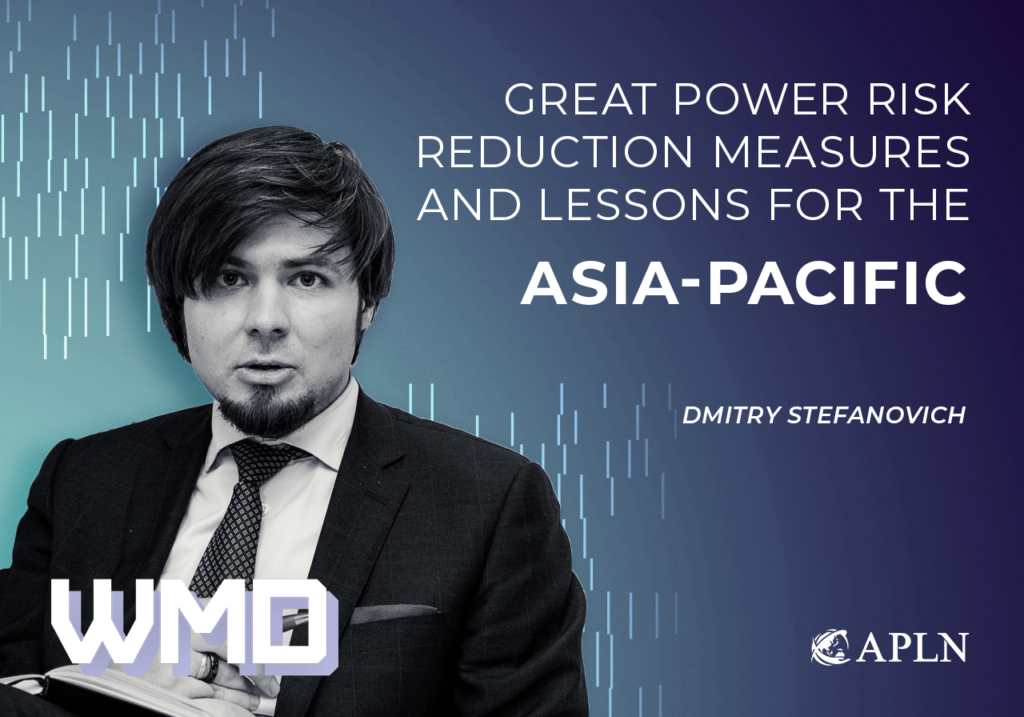
Dmitry Stefanovich, Research Fellow at the Center for International Security, introduces the concept of Risk Reduction Measures and explains why they are required.